- Where is the main shutoff on a Pine Ridge property?
It varies, and on a one to three acre lot (JJ Naples, 2026) it can be a considerable distance from the house, often near the frontage and frequently overgrown. It is worth locating and testing while nothing is wrong rather than searching for it while water is running.
- Why does finding the cleanout matter?
It is the access point for clearing a blocked lateral. On acreage the cleanouts can be well away from the house and hard to find in the dark, and time spent locating them is time the backup continues.
- Where is the main shutoff likely to be?
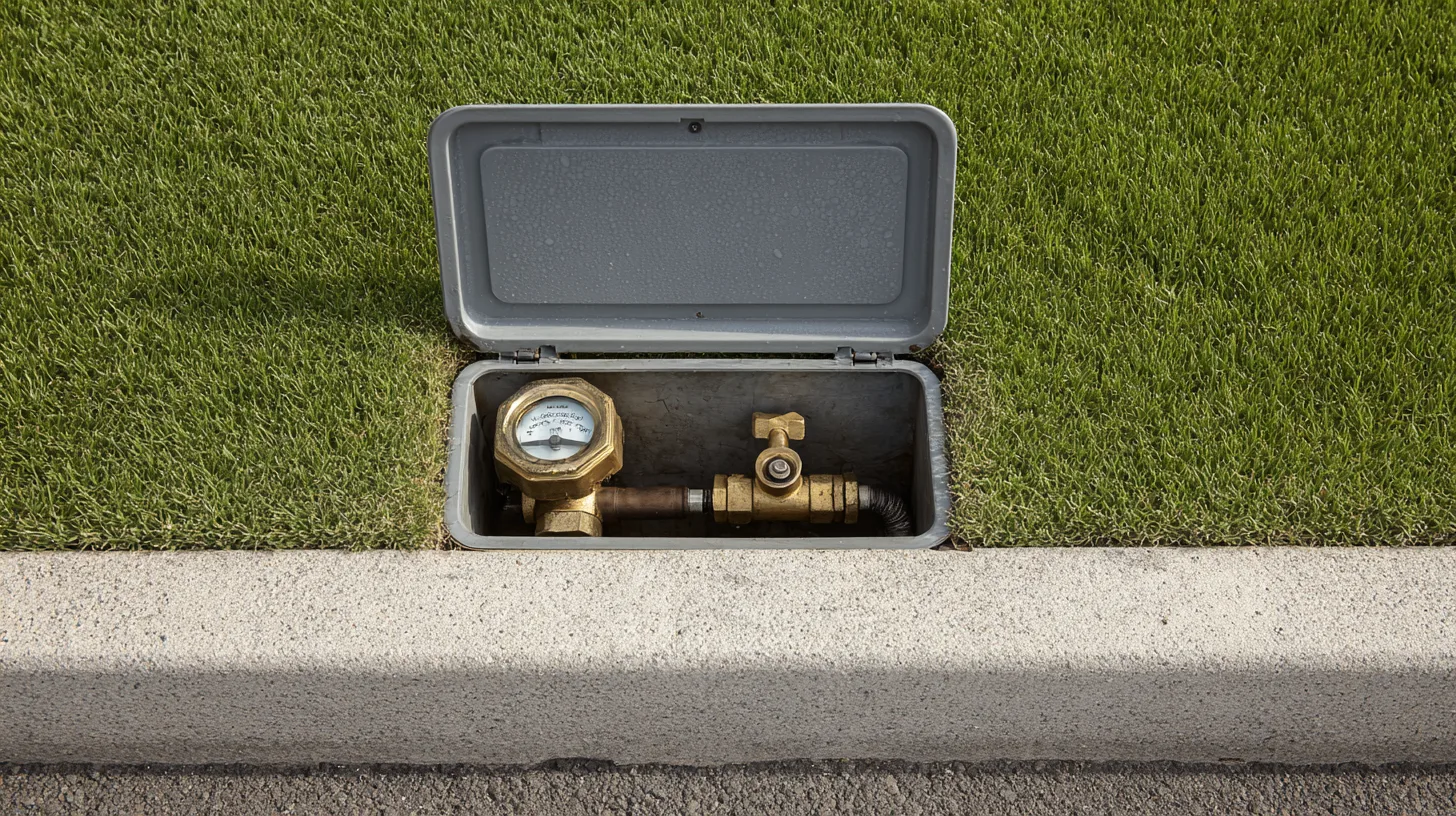
Near the frontage rather than near the house, which on an acreage lot means a considerable walk. It is typically in a box at or near the property boundary where the service enters, and on a lot that has been landscaped over sixty years it is frequently overgrown, buried under mulch, or hidden behind planting that was not there when it was installed. That is why locating it and marking it is worth doing on an ordinary afternoon. The alternative is searching a large dark property with water running, which is the situation this page exists to prevent.
- Should there be a second shutoff closer to the house?
On a property this size, frequently yes, and it is a modest job that pays for itself the first time it is needed. A valve at the building means containment in seconds rather than after a walk to the frontage, and it also allows work on the house without isolating the irrigation or anything else fed from the service line. Where a property has a well rather than a municipal service the same logic applies to isolating the house from the pressure system. Either way, the useful question is how quickly water can be stopped from where you are standing when it starts.
- What else needs isolating on a property like this?
More than in a compact house. Irrigation typically has its own valve and its own controller, and an irrigation failure on acreage can run a great deal of water before anyone notices. Pool equipment, outbuildings, guest accommodation and any secondary structure may each have supply that can be isolated separately. Knowing which valve serves what turns a whole-property shutdown into a targeted one, which matters when the failure is in an outbuilding and the main house is occupied. A simple labelled map of the valves is the whole solution and it takes one afternoon.
- How long will help take to arrive?
Longer than in the coastal grid neighborhoods, and it is worth planning around rather than hoping otherwise. That travel reality is exactly why the preparation on this page carries more weight here: knowing where valves are, confirming they turn, and being able to isolate the affected part of the property determines the outcome more than dispatch speed does. After-hours work also runs 1.5 to 2 times standard on a weeknight and higher at weekends (Nearby Hunt, 2026), so containing a situation and calling in the morning is frequently both cheaper and no worse for the property.
- What are the most common emergencies here?
Supply connector failures inside the house, exactly as anywhere else — they are pressurised continuously and fail without warning. Irrigation line breaks are second and are more consequential on acreage because the volume is high and the failure is outdoors where nobody sees it. Water heater failures are third. And blockages in the long lateral are fourth, which present as multiple fixtures backing up rather than one. The first three are contained by valves; the fourth is contained by not adding water, which is the least intuitive response and the correct one.
- Is a leak outdoors as urgent as one indoors?
Financially it can be worse, because it runs unnoticed. A break in an irrigation line or a service run on a large lot does not damage the house, so nothing prompts anyone to investigate, and the loss continues at whatever rate the break allows until a bill arrives a cycle later. The meter test is the practical safeguard: with everything off, a moving meter means water is leaving the system somewhere, and on a property with a lot of buried pipe that check is worth running periodically rather than only when something seems wrong.
- What if the property is on a well?
Then a power cut is a water cut, because nothing pumps without electricity. The pressure tank holds a short reserve and once that is drawn there is no water at any fixture, including for flushing. On a large property that is a more consequential situation than it sounds, particularly in a region where storm outages are routine. A generator sized for the well pump specifically — rather than for the whole house — is comparatively inexpensive and restores the utility that matters most. Storing water ahead of a forecast storm is the free version of the same precaution.
- What about outbuildings and guest accommodation?
They are frequently the forgotten part of an emergency plan on a large property. A secondary structure has its own supply, its own fixtures and frequently its own water heater, and a failure there can run for a long time because nobody is in it. If those structures can be isolated separately, knowing which valve does it turns a whole-property shutdown into a targeted one. If they stand empty for periods, the same logic as a seasonal property applies: close the valve rather than leaving everything pressurised for nobody.
- What should be marked and where?
The main shutoff, every cleanout, the irrigation isolation, and if the property is on private systems, the tank access lids and the well head. Marking means something durable and findable in the dark — a marker post, a paver, or at minimum a photograph with landmarks and a measurement from something permanent. Mulch moves, planting grows and memory fades, so the marking that works is the one that survives a season of landscaping. A simple sketch of the lot with those points on it, kept somewhere accessible, is the whole system and it costs nothing.
- Is a leak detection check worth running periodically?
On a property with this much buried pipe, yes. The meter test takes minutes: with every fixture, appliance and irrigation zone off, watch the low-flow indicator. Movement means water is leaving the system somewhere. On a compact lot a leak surfaces or shows indoors fairly quickly; on acreage a break in a buried service or irrigation run can lose a great deal before anything indicates it. Running the check quarterly rather than never is the difference between finding a loss in weeks and finding it on a bill.
- What should you do if water is running and you cannot find the source?
Close the main first, then diagnose. That single action converts an accumulating problem into a static one and buys the time to think, which on a large property matters because searching takes longer. Then work outward: is the house dry, is the irrigation running, is any outbuilding affected. If closing the main stops it, the source is on the pressurised supply somewhere. If it continues, it is drainage or groundwater rather than supply, which is a different problem entirely and rarely as urgent.
- How does the water table affect an emergency here?
It makes ground conditions part of the problem. A high water table means any excavation fills, so a repair that would be straightforward elsewhere may need pumping to keep the trench workable — which adds time on a day when time matters. It also means that standing water on the property during a failure is not automatically evidence of where the leak is, since saturated ground moves water in ways that mislead. That is why the meter test is more reliable than observation here: it answers whether water is leaving the system, regardless of where it appears.
- What should be in a property file?
A sketch of the lot showing the main shutoff, cleanouts, irrigation isolation, and if the property is on private systems the tank access and well head. The date of the last tank pumping and the last camera inspection. Contact numbers for both a plumber and a septic contractor, since half the emergencies on a property like this belong to one and half to the other. And a note of which valve isolates what. That file is a single sheet of paper and it is the difference between a contained incident and a search.
- Does the property size change the insurance picture?
Not directly, but it changes the exposure. More buried pipe, more outbuildings and more irrigation mean more places a failure can occur unobserved, and a leak outdoors on acreage can run for a long time before anything indicates it. That makes the periodic meter check more valuable here than on a compact lot, and it makes the sudden-versus-gradual distinction that policies frequently draw more consequential — because a slow outdoor loss is the kind most likely to be characterised as gradual.
- What is the realistic expectation to set?
That on a property this size, the first twenty minutes are yours. Travel time from the developed coast is real, after-hours rates run 1.5 to 2 times standard on a weeknight and higher at weekends (Nearby Hunt, 2026), and no dispatch promise changes either. What that means practically is that preparation is worth more here than responsiveness — a marked shutoff that turns, a known cleanout, a labelled valve map. Those determine the outcome; the arrival time determines when the repair starts.
- What should you do if the shutoff will not turn?
Stop before it breaks, because a snapped valve converts a contained problem into an uncontained one at the worst possible moment. If the valve resists, the fallback is the curb stop at the meter, which the utility can operate and which some homeowners can reach with the correct key. That is the reason for testing the main valve on an ordinary afternoon — a seized valve discovered dry is a small scheduled job, and the same valve discovered during a failure is a serious problem with no good options.
- How do you decide whether it can wait until morning?
By whether the damage is still accumulating. Water you cannot stop, sewage entering the house, or anything involving electricity does not wait. A contained leak with the supply closed, a single blocked fixture with others working, or no hot water can. The test is not how alarming it looks but whether the situation is getting worse while you decide — and on a property where after-hours rates run 1.5 to 2 times standard on a weeknight and higher at weekends (Nearby Hunt, 2026), that distinction is worth making deliberately.
- Is a generator worth it here?
On a well property, yes — sized for the pump rather than the house, it restores water rather than convenience during an outage.


 JAMIE KLONCZ · GREAT HERON PLUMBING ONLINE