
Guide
Cast iron fails from the inside, which is why nobody sees it coming
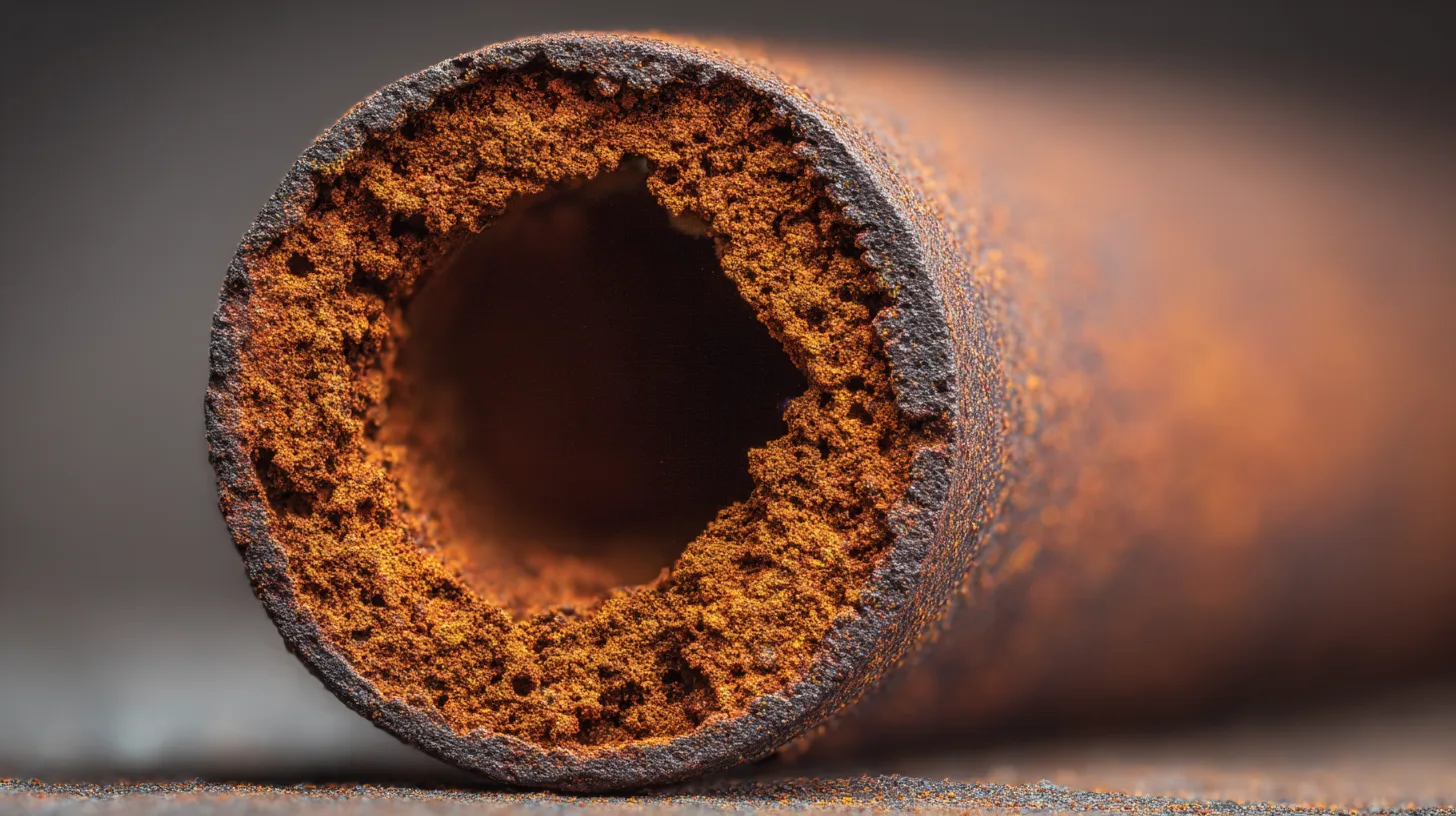
The pipe looks intact from every angle you can see it. The wall thins from the bore outward, and by the time a symptom reaches a fixture the failure is well advanced.
Get a plumbing quoteLast reviewed
Cast iron drain pipe corrodes internally as sewer gases and moisture attack the pipe wall, roughening and thinning it from the bore outward. Homes built before the mid-1970s frequently still have it. Failure presents as recurring backups, sagging floors or sewage odor rather than as a single visible break.
Does your Naples home have it?
Build date is the strongest indicator by a distance.
Collier County has a very large proportion of homes built before 1972 with cast iron drain lines underground (Revolution Florida, 2026). If the house predates the mid-1970s and the drains have never been replaced, cast iron is the reasonable assumption rather than the exception.
Where you can sometimes see it: exposed sections in a garage, a crawl space, or where the stack passes through a utility area. Cast iron is heavy, dull gray to black, and sounds solid rather than hollow when tapped. Plastic drain pipe is unmistakably lighter and usually white or black.
What you cannot tell from the exposed section is the condition of the buried run, because the corrosion is internal and the exterior can look sound throughout. That is the entire diagnostic problem.
The failure mechanism, and why humidity makes it worse here
Attacked from both sides at once.
The interior surface is exposed to sewer gases, moisture and the chemistry of what passes through it. Corrosion products build, the surface roughens, and the wall thins. A roughened bore then catches grease, paper and debris that a smooth pipe would carry, so blockages become more frequent as the pipe ages — the deterioration accelerates itself.
In coastal Florida the exterior is under attack as well. A high water table keeps buried pipe permanently wet and soil movement after heavy rain stresses joints (First Choice Plumbing Solutions, 2026), so the line is degrading from both surfaces at once.
This is why symptoms cluster rather than appear singly. Recurring blockages, odor and slow drains usually arrive together, because they are one process at different points along the same run.
What the repair costs in 2026
A wide range, and the method is what sets it.
Traditional excavation to replace cast iron typically takes four to eight weeks, destroys floor surfaces and cabinetry, and runs in the region of 50,000 to 75,000 dollars (Trenchless Pipe Lining, 2026).
Trenchless pipelining can restore the pipe in three to four days without digging, at around 17,000 dollars for a typical 2,000 square foot home (Trenchless Pipe Lining, 2026). Relining four inch cast iron runs about 125 dollars per foot outdoors and 140 dollars inside (Trenchless Pipe Lining, 2026).
Standalone replacement more broadly runs about 10,000 to 20,000 dollars, but the same work during a remodel that already has floors open falls to roughly 3,000 to 8,000 dollars (Revolution Florida, 2026). If a renovation is being planned on an older property, the drain line is worth inspecting before the schedule is fixed rather than after.
What to do with the information
Establish the facts, then decide on your own timeline.
A camera inspection establishes the pipe material, the internal condition, the grade and the location of any defect. That converts an unknown liability into a dated planning item.
A degraded but functioning line is not an emergency. It is a decision about when, and knowing it exists lets you schedule around a remodel, a sale, or a budget cycle instead of reacting to a failure at an unhelpful moment.
If a repair has already been quoted without an inspection, that is worth questioning. The choice between a three-day lining job and a six-week excavation is decided by what the camera shows, and a quote issued without one has been issued without the deciding fact.
How does cast iron actually fail?
From the inside, along the bottom, invisibly. By the time it shows at the surface the pipe has been failing for years.
Cast iron corrodes from the inside out, which is the single fact that makes it different from every other failure on a property. There is no external sign, no dampness, no staining — the pipe looks identical from the outside on the day it fails and the day it was installed.
The corrosion is not uniform around the bore. Waste flows along the bottom of a horizontal drain, so the invert — the lowest part of the pipe — is in constant contact with effluent while the crown above it is not. The result is that cast iron wears from the bottom upward, and a camera frequently shows a pipe whose top half looks serviceable while the bottom has thinned or gone entirely.
As the surface corrodes it roughens, and the roughness is what accelerates everything else. A smooth bore passes waste; a pitted one gives grease, scale and solids something to catch on, which builds deposit, which holds more waste against the wall, which corrodes further. The process compounds rather than progressing linearly.
Channelling is the late stage: the invert has worn through and waste is running in the soil beneath the pipe rather than in the pipe. A line in that condition can still pass water, which is why it produces no symptoms, and it is also why it cannot be jetted — there is nothing left at the bottom to jet against (US Pipelining Services, 2026).
The failure that finally announces itself is usually a blockage rather than a collapse, because the roughened surface catches something. That is why the first sign of a decades-long process is frequently a slow drain, and why treating that slow drain as an isolated blockage misreads it.
Why is this a Collier County problem specifically?
Housing age plus local conditions. The county has an unusual concentration of the exact era that used the material.
Collier County has a very large proportion of homes built before 1972 with cast iron drain lines underground (Revolution Florida, 2026). That is the era when the material was standard, and it is a substantial share of the housing stock here rather than a minority of it.
The neighborhood pattern follows the building history precisely. Naples Park opened in the 1950s with streets paved late that decade (Naples Condo Boutique, 2026), Golden Gate was platted in 1960 (ActiveRain, 2026), Pine Ridge Estates was developed by the Collier family in the 1960s (JJ Naples, 2026), and Marco Island opened in 1965 (Coastal Breeze News, 2026). All of that is inside the window.
Local conditions then work against the pipe from outside as well as in. A high water table keeps the exterior of buried pipe permanently wet, soil movement after heavy rain shifts and stresses joints, and the warm humid environment accelerates deterioration generally (First Choice Plumbing Solutions, 2026).
The counterweight is worth stating, because writing as though every Naples house has failing cast iron would be wrong. Many Naples Park residences were built between 1970 and 1999 (Naples Florida Vacation Homes, 2026), Lely Resort was built out after 2000, and Bonita Springs grew in the 1980s and 90s (City of Bonita Springs, 2026) — all outside the window.
So the era argument sets the odds for a neighborhood; it does not settle any individual address. That is exactly the gap a camera closes, and it is why an inspection is worth more here than a general statistic about the county.
What are the options once a line is confirmed failing?
Three, and the choice is driven by how much of the run is affected rather than by preference.
Spot repair addresses a single localised fault — a separated joint, a short channelled section — by excavating at that point and replacing a few feet. It runs roughly $1,500 to $4,000 including excavation (HomeGuide, 2026) and it is the right answer when the camera shows sound pipe either side of a defined problem.
Lining rehabilitates the existing pipe rather than replacing it. A resin liner is installed inside the host pipe and cured in place, producing a new pipe within the old one without a trench. CIPP lining is the most predictably priced of the options at $70 to $150 per linear foot (Charles & Hudson, 2026), and locally there are established providers doing this work (Trenchless Pipe Lining, 2026).
Full replacement is the answer where the line has degraded along its length rather than at points. Traditional excavation runs $5,000 to $15,000 or more (Four Seasons, 2026), and the number that surprises people is not the pipe — it is the $3,000 to $8,000 of restoration that excavation adds and trenchless avoids (Charles & Hudson, 2026).
The decision is genuinely made by the camera rather than by argument. A line with one fault and sound pipe elsewhere is a spot repair. A line with general internal loss is not, and lining or replacing it is a question about access and what sits above the run.
One qualifier specific to cast iron: lining requires enough remaining host pipe to line against. A run that has channelled through the invert over a long distance may not have it, which is why the assessment has to be done properly rather than assumed from the outside.
And the option that is not on the list: continuing to clear it. Once the camera shows material loss rather than deposit, cleaning is managing a decline on a shortening interval, and each clearing is being paid at full price for less time.
What should you do if you own one of these houses?
Establish the condition, then plan around it. The expensive version of this is finding out during a failure.
Start by establishing whether it is actually cast iron and what condition it is in. The era sets the odds — a very large proportion of pre-1972 Collier County housing carries it (Revolution Florida, 2026) — but it does not settle an individual property, particularly where sections have been replaced already.
Get a dated camera baseline. On a line that is deteriorating rather than failed, the single most useful thing is a recorded condition at a known date, because it makes the next inspection a comparison rather than another opinion. Without a baseline, every future assessment starts from zero.
Then treat it as a planned capital item rather than a repair budget. A line with material loss has a remaining life, and the difference between replacing it on your schedule and replacing it after a backup is the difference between a quoted job and an emergency one — with after-hours rates running 1.5 to 2 times standard on a weeknight and higher at weekends (Nearby Hunt, 2026).
Adjust the interim maintenance to match. On thinned cast iron, high-pressure jetting can worsen existing weaknesses (Benjamin Franklin Plumbing, 2026), so clearing should be mechanical and gentle rather than aggressive, and that trade-off — shorter intervals in exchange for not damaging the pipe — should be a conscious decision rather than a surprise.
If you are selling, get the inspection before the buyer does. The finding is identical either way; what differs is who controls the timing, the contractor and the remedy.
And if you are buying, commission the sewer scope specifically. It is a separate add-on service requiring a licensed plumber or certified inspector, and many buyers assume the standard inspection covers it (Home Inspecto, 2026). On a house in this era, that assumption is the most expensive one available.
Questions about this work
Direct answers, no sales pitch.
 JAMIE KLONCZ · GREAT HERON PLUMBING ONLINE
 Pick a question on the left, or search above. You will get the direct answer, the way an answer engine would give it.
Sources
Where we work
The interactive map is not loading right now. The areas it covers:
- Naples (Core market) — The center of the service area. Every service page is written for Naples first.
- North Naples (Condo and HOA) — Planned communities and stacked buildings, where a pipe may belong to the association rather than the unit.
- Golden Gate (Septic and sewer) — Sold in 1960 with no public utilities. Some properties are on county sewer, some still on their own tank.
- Pine Ridge (Acreage lots) — One to three acre lots from the 1960s, which puts a long private lateral between the house and the main.
- Lely Resort (Post-2000) — Built out after 2000, past both the cast iron and the polybutylene eras.
- Naples Park (Pre-1972) — Streets paved in the late 1950s, squarely inside the window when cast iron was standard.
- Marco Island (Coastal, 1965 on) — Opened in 1965 and built across the material boundary, so the build phase decides the pipe.
- Bonita Springs (Lee County) — Grown in the 1980s and 90s. Young enough that pipe age is rarely the fault.
Contact
Tell us what is happening
The more you can say about the property — the neighborhood, roughly when it was built, and what it is connected to — the more useful the first answer will be.
Call (239) 404-8590Know what you need? Pick a time online and see what we actually have free.