
Naples and Collier County
Why polybutylene is replaced whole rather than in sections
With most pipe, you replace what failed. With this one, what failed is only the first part to reach the end of a process running everywhere at once.
Get a plumbing quoteLast reviewed
Polybutylene replacement removes gray polybutylene supply pipe throughout a property and installs new supply lines to every fixture. Partial replacement is generally not appropriate because chlorine degradation acts along the whole length of the material rather than at the point that happened to fail first.
Why partial replacement does not hold
The failure is a stage, not an event.
Chlorine in treated water reacts with the polymer at the internal surface, micro-fractures propagate outward, and the material embrittles. That process runs at a similar rate everywhere the same water is flowing.
The fitting that leaks first is the one under most mechanical stress, not the only one that is degraded. Replacing it returns the system to the state it was in a month earlier, with every other fitting on the same trajectory.
This is why the characteristic pattern is repeated small leaks at joints over a period rather than one large failure. Each repair is a reasonable decision in isolation and a poor one in aggregate.
What the scope covers
Everything the polybutylene touches.
All accessible polybutylene supply pipe is replaced: mains within the property, branch lines, and the connections at each fixture. New lines are routed to every fixture rather than spliced into the existing runs.
The old pipe inside walls and under slab is isolated and abandoned in place rather than extracted, because removing it opens far more of the structure than replacing it requires.
What is not included: drains, which are a separate system entirely. On a property of the right age it is worth assessing both, since a house piped in polybutylene may also be near the end of its drain line life.
Identifying it before committing to anything
Confirm the material, then decide.
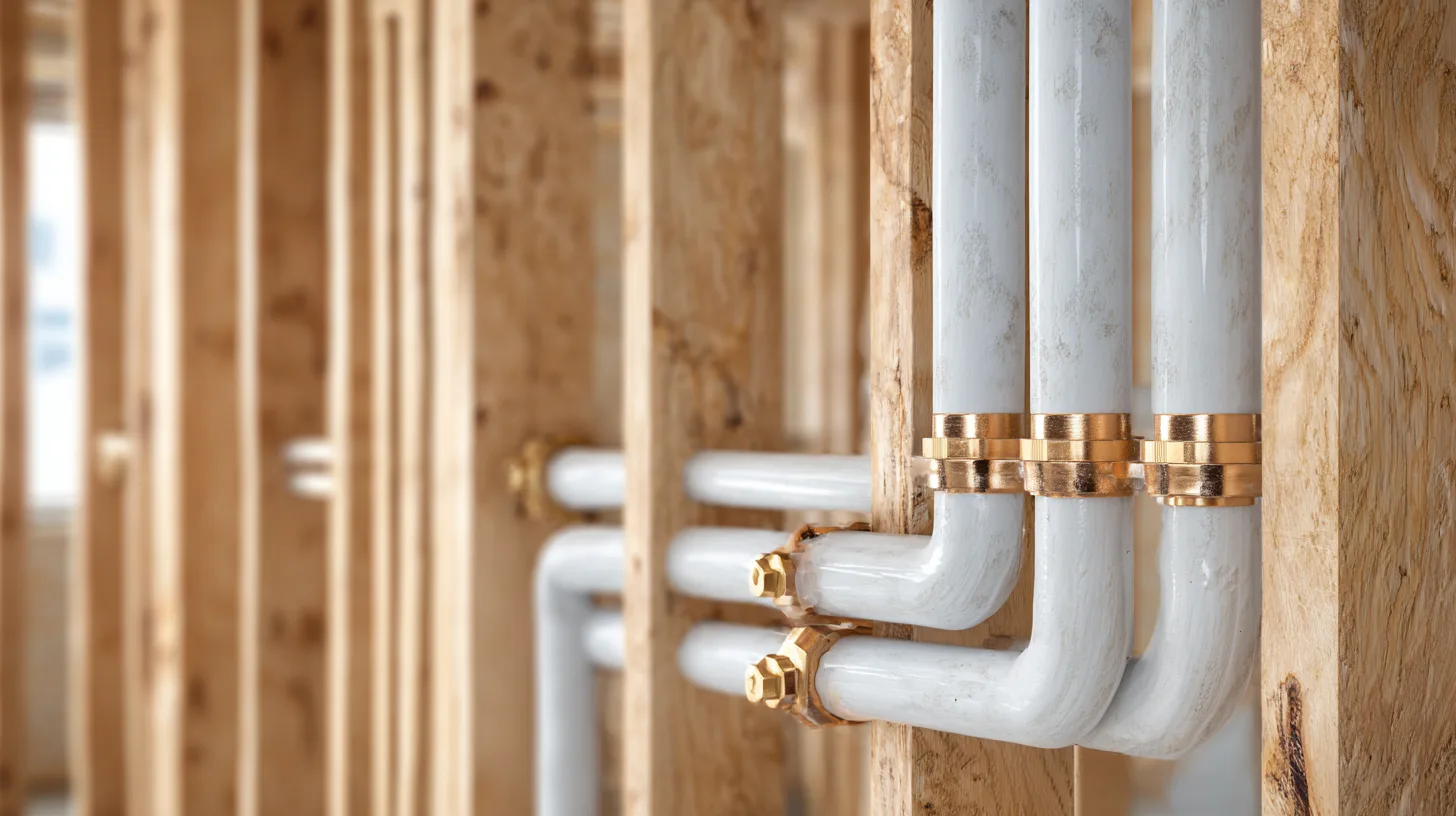
Polybutylene is gray, though blue and black exist, flexible rather than rigid, and typically stamped "PB" with a code beginning 21. Visible at the water heater, under sinks and at the main shutoff.
A visible section confirms the material is present. It does not establish how much of the system is polybutylene, since properties are sometimes partially replumbed over the years without records.
Establishing the actual extent is the first step of scoping. A quote for replacing all of it, on a house where half was already done in 2004, is a quote for work that does not exist.
Living in the house during the work
Predictable, and worth agreeing up front.
The supply is off during working hours on changeover days and typically restored each evening where the route is overhead. On a slab route the interruption is longer.
Walls are opened at drop points rather than along runs, so disruption is concentrated rather than general. In bathrooms and kitchens that can mean tile.
The two questions worth settling in writing: how many days the water is off and when it is restored, and what standard the openings are made good to. Both vary between contractors and neither is visible in a headline price.
How much does polybutylene replacement cost?
Roughly $1,500 to $7,000 for most houses, scaling with bathrooms rather than square footage.
Replacing polybutylene with PVC or CPVC in a small one-bathroom home costs about $1,500 to $2,500, and $3,000 to $7,000 for a larger home with two or more bathrooms (Angi, 2026). Across all property sizes the reported range runs from $150 for a minor section to $5,100 for a substantial job (Angi, 2026).
Materials are a small share of it. Pipe maxes out around $8 per linear foot with labor accounting for most of the cost, and hiring a plumber runs $45 to $200 per hour (Angi, 2026). CPVC is the most affordable and most common replacement choice at $0.50 to $1 per linear foot (Angi, 2026).
Fixture count is the better estimating basis than floor area, because the work follows the plumbing rather than the walls. Repipes scale at roughly $650 to $1,500 per fixture across all materials (Home Fix Cost Guide, 2026), counting every sink, toilet, tub, shower and appliance connection.
And the local multiplier applies here as it does to any repipe. Slab foundations push costs 25 to 50 percent higher because lines must be rerouted through attics and walls rather than run beneath the floor (Angi, 2026), which is the standard condition across Southwest Florida.
Why replace polybutylene before it fails?
Because the failure mode is not gradual, and the cost of the damage is not related to the cost of the pipe.
Most plumbing decisions are legitimately reactive. A tap drips, a drain slows, and the symptom gives you time to plan. Polybutylene is the case where that logic does not hold well, because the material degrades internally and fails at fittings and along runs without the progressive warning that makes waiting rational.
The asymmetry is what drives the recommendation. A planned replacement in a small home costs $1,500 to $2,500 (Angi, 2026), scheduled at your convenience, with walls opened deliberately and closed properly. An unplanned failure costs the same plumbing work plus water damage, plus emergency rates, plus whatever the water reached.
The insurance dimension makes it sharper. Insurers are aware of the material's history, and a property with documented polybutylene can face higher premiums, coverage conditions, or difficulty at renewal. A completed replacement with permit and inspection records is what changes that.
Resale is the third pressure. Polybutylene is identified in inspections and it becomes a negotiating point, usually at a number less favorable than doing the work yourself would have been.
The honest counterweight: a house that will be sold shortly, or one where the pipe is known to have been partially replaced already, deserves a specific assessment rather than a blanket recommendation. What makes polybutylene unusual is that the general answer leans toward acting early, where for most materials it leans toward monitoring.
How do you know whether a house has polybutylene?
It is identifiable on sight in the places it is visible, and those places are usually accessible without opening anything.
The pipe itself is typically gray, though blue and black were also produced, and it is flexible plastic rather than rigid. It is most commonly stamped with a code beginning PB, and the marking is the definitive identifier where it can be read.
Look where plumbing is exposed rather than where it is buried. The water heater connections, under sinks, at the main shutoff, and at any hose bib or laundry connection are the practical places, and on a slab property the incoming main near the meter is frequently visible.
Age narrows it before you look at anything. The material was widely installed in housing built roughly between the late 1970s and the mid 1990s, so a property finished outside that window is unlikely to have it, and one finished inside it is worth checking properly.
Partial replacement is common and it complicates the answer. Many properties have had visible sections replaced while the runs inside walls were left, which produces a house that looks modern at every accessible point and is not. Finding CPVC at the water heater is not evidence that the rest was done.
Where visual inspection is inconclusive, a plumbing inspection covering the accessible supply system settles it, and on a property being purchased it is worth commissioning specifically rather than assuming a general inspection addressed it.
One thing not to rely on: the seller's recollection, or a disclosure that says the plumbing was updated. Both are frequently offered in good faith and describe partial work.
What replaces it, and does the choice matter?
CPVC and PEX are the realistic options here. The difference is mostly in how the work is done rather than how it performs.
CPVC is the most affordable and most common replacement, at $0.50 to $1 per linear foot (Angi, 2026), and it is familiar to every plumber in this market. It is rigid, which means it is joined with solvent-welded fittings and routed in straight runs with elbows — closer to how the original system was probably built.
PEX is flexible and runs $0.40 to $2 per linear foot (Home Fix Cost Guide, 2026). The flexibility is the practical advantage on a slab property: it can be pulled through walls and around obstructions with far fewer fittings, and fewer fittings means fewer potential failure points and less wall opened to install it.
Copper remains available at $2 to $8 per linear foot (Home Fix Cost Guide, 2026) and is the most expensive by a wide margin. It is also the material most exposed to water chemistry, which in a hard-water region is a consideration rather than a footnote.
For most Southwest Florida repipes the real decision is between CPVC and PEX, and it is frequently decided by the contractor's preference and the routing the house demands rather than by performance. Either is a substantial improvement on what is being removed.
What matters more than the material is the scope. A replacement that leaves runs inside walls because they were inconvenient to reach has recreated the original problem in a smaller area, and the fact that it is smaller does not make it easier to find later.
Ask for the scope in writing, by run rather than by room, and ask specifically what is being abandoned in place versus removed. On a slab property abandoning the old pipe is normal and correct — but it should be capped and isolated deliberately, not simply disconnected and left.
What happens to the walls, and how long does it take?
Days rather than weeks for the plumbing. The finishing work is the part that determines how long the house feels disrupted.
On a slab property the new lines run overhead — through the attic and down inside walls to each fixture — because routing beneath the floor is not available without breaking concrete. That is what drives the 25 to 50 percent slab premium (Angi, 2026) and it decides where walls are opened.
Openings are cut at drop points and manifold locations rather than continuously. A crew that has thought about the route makes fewer and better-placed openings than one that has not, and asking to see the intended cut locations before work begins is a reasonable request that also tells you something about the contractor.
The new system is installed alongside the existing one while it is still live, so the house keeps water for most of the job. The genuine water-off period is the changeover and pressure test, which is measured in hours rather than days.
Pressure testing before anything is closed up is the step to insist on. A joint that weeps behind new drywall costs the drywall a second time, and testing while everything is open is the only cheap moment to find it.
Then finishing, at $300 to $1,500 or more (Angi, 2026), and frequently a separate trade. This is where timelines slip and where quotes diverge, so establishing whether the plumbing contractor closes and finishes, or leaves it for you to arrange, is worth doing before signing rather than after.
For a household in occupation the practical planning is around the changeover day and the finishing schedule, not around the plumbing itself. The plumbing is the fast part.
Questions about this work
Direct answers, no sales pitch.
 JAMIE KLONCZ · GREAT HERON PLUMBING ONLINE
 Pick a question on the left, or search above. You will get the direct answer, the way an answer engine would give it.
What does a repipe actually involve in a home like yours?
Three questions about the house. You get the scope and how long the water is off — the two things that actually decide what a repipe means for you. No price is shown here, because pricing depends on a walkthrough of the real house.
Indicative scope only, not a quote and not an inspection. Actual scope is set by a walkthrough of the real house.
Sources
Where we work
The interactive map is not loading right now. The areas it covers:
- Naples (Core market) — The center of the service area. Every service page is written for Naples first.
- North Naples (Condo and HOA) — Planned communities and stacked buildings, where a pipe may belong to the association rather than the unit.
- Golden Gate (Septic and sewer) — Sold in 1960 with no public utilities. Some properties are on county sewer, some still on their own tank.
- Pine Ridge (Acreage lots) — One to three acre lots from the 1960s, which puts a long private lateral between the house and the main.
- Lely Resort (Post-2000) — Built out after 2000, past both the cast iron and the polybutylene eras.
- Naples Park (Pre-1972) — Streets paved in the late 1950s, squarely inside the window when cast iron was standard.
- Marco Island (Coastal, 1965 on) — Opened in 1965 and built across the material boundary, so the build phase decides the pipe.
- Bonita Springs (Lee County) — Grown in the 1980s and 90s. Young enough that pipe age is rarely the fault.
Contact
Tell us what is happening
The more you can say about the property — the neighborhood, roughly when it was built, and what it is connected to — the more useful the first answer will be.
Call (239) 404-8590Know what you need? Pick a time online and see what we actually have free.