
How Salt Air and Canal Living Wear Out Outdoor Plumbing on Marco Island
Marco Island outdoor plumbing lives in one of the harshest residential environments a fixture can be installed in, and the fixtures show it: hose bibs that seize in a few seasons, valve handles that crumble, fasteners that bleed rust down a wall. None of this is bad luck. Corrosion is a global, measurable force, one whose annual cost exceeds $2.5 trillion (AMPP, 2025), and a canal home concentrates it. The good news is that the wear is predictable, and predictable problems can be bought against.

Salt air corrosion is electrochemistry, not weathering. Airborne salt spray deposits chloride on every outdoor surface, chloride attacks the passive oxide layers that protect metals, and Florida's humidity keeps the reaction fed between rains. On a canal or sea-facing lot the deposition rate climbs with every foot closer to the water, which is why the same brass hose bib lasts differently on Marco Island than it does ten miles inland in Golden Gate.
What salt air actually attacks
Chloride is the specific culprit. It penetrates and destabilizes the thin oxide films that make metals passive, opening the door to pitting: deep, localized attack that perforates a part while most of its surface still looks fine. That is why coastal fixtures often fail suddenly at one point, a pinhole, a snapped stem, rather than fading uniformly.
The attack is selective about metals. Bare steel and zinc coatings go first, which is why galvanized parts streak rust here quickly. Cheap brass suffers dezincification, a process where chloride-rich water leaches the zinc out of the alloy and leaves behind a weak, copper-colored sponge that looks intact and breaks under a wrench.
Corrosion is also manageable, which is the half of the story sellers of stainless upgrades skip: the industry's own campaign material notes that proven corrosion control practices could save up to 35% of corrosion's costs (AMPP, 2025). For a homeowner, control means material choice plus a few habits, both covered below.
Canal front versus inland: the exposure gradient
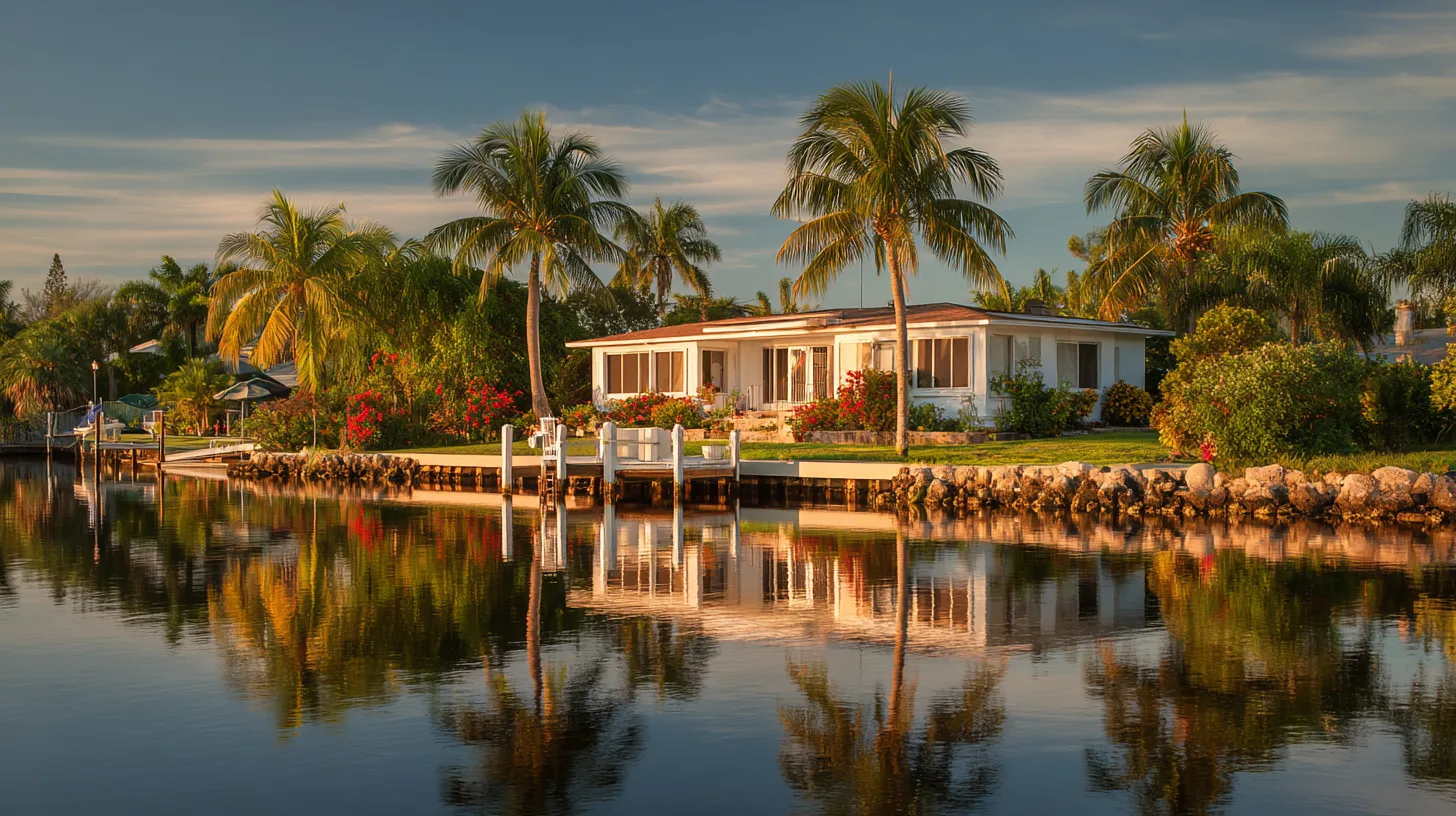
Salt deposition falls off with distance from open water, so exposure is a gradient, not a switch. A dockside spigot on a south-facing canal takes the worst of it: spray, reflected sun, and constant humidity. The same fixture behind the house, shielded by the structure, may see a fraction of the chloride load. Wear patterns around one house map that gradient.
This is why neighbors argue from different facts. A canal-front owner on the water replaces outdoor hardware on a rhythm an inland owner would not believe, and both are describing their own exposure honestly. It is also why the water-facing side of a single house ages faster than its street side.
Reading your own gradient is useful: the fixtures that fail first on your lot are telling you where the chloride concentrates. That is the side where material upgrades pay for themselves, and where anything sacrificial, coated steel brackets, zinc-plated clamps, standard fasteners, will announce the problem first.
The materials that survive here
For exposed coastal metalwork the step up is grade 316 stainless steel, alloyed with 2 to 3 percent molybdenum (ASSDA, 2026). Its advantage over the common 304 grade is an "increased ability to resist pitting and crevice corrosion in warm chloride environments," and it is the standard choice for "sea-front buildings and fittings on wharves and piers" (ASSDA, 2026).
The same body notes that 316 is often simply called the marine grade (ASSDA, 2026). In fasteners, the designation to ask for is A4, which is 316's designation under the international fastener standard (ASSDA, 2026); A2 is the 304 equivalent and the one that quietly rusts on canal homes.
Where metal is not required, plastics sidestep the chemistry entirely: PVC, CPVC, and PEX do not corrode, which is why modern outdoor supply runs and irrigation manifolds here are largely plastic with metal only at the termination points. For brass that must stay brass, dezincification-resistant alloys exist, marked DZR or CR, and they are the difference between a valve body that lasts and one that powders.
The fixtures worth upgrading first
Spend the upgrade money where water, metal, and salt meet: the dockside and pool-deck hose bibs, the outdoor shower, valve handles and stems, and every exposed fastener and bracket holding pipe to a seawall or dock. These are the parts whose failure either strands you without water control or lets a small leak run at the worst spot on the property.
Hose bibs earn the first dollar because they combine every risk: constant moisture, direct spray, frequent handling, and a connection into the house's supply. A quarter-turn ball valve bib in a marine-rated body, with a 316 or DZR trim, converts the most-touched fixture on the lot from a recurring failure into hardware you stop thinking about.
The second dollar goes to whatever anchors plumbing to the dock or seawall, because a corroded strap lets vibration and movement do mechanical damage no alloy resists. When replacement crosses into supply-line work, use a licensed plumber and verify the license against the state database first (Florida DBPR, 2026).
The maintenance that actually helps
Three habits move coastal fixture life more than any product: rinse exposed hardware with fresh water on a regular rhythm to wash the chloride off, exercise outdoor valves a few times a year so corrosion never gets to finish a seizure, and inspect the sacrificial parts, fasteners, clamps, brackets, each season as your early-warning system.
The freshwater rinse sounds too simple to matter, which is why it is skipped. Salt does its damage while it sits on the surface between rains; a hose-down after windy spray days interrupts the chemistry at zero cost. Marinas preserve six-figure boats with the same habit.
Valve exercising is the same discipline our shutoff valve guide teaches for the main: a valve that turns a few times a year does not get the uninterrupted decades a seizure needs. For seasonal owners, fold both habits into the departure and arrival routine the snowbird guide covers, and the house's most exposed hardware gets attention exactly when the house is most vulnerable.
This article, answered
The questions readers ask about this topic, answered the way an answer engine would. No forms, no sales pitch.
JAMIE KLONCZ · GREAT HERON PLUMBING ONLINE Pick a question on the left, or search above. You will get the direct answer, the way an answer engine would give it.
PUBLISHED August 25, 2026 · WRITTEN BY JAMIE KLONCZ, FOUNDER · GREAT HERON PLUMBING